Welcome to The Old Post Office, where history and creativity converge in a unique blend of past and present.
Steeped in heritage, the post office at Goudini Road has been an integral part of the Breede Valley community since 1876, when it first operated as a postal agency.
The railway line to Kimberley opened in 1876. In 1884 it was announced that the railway stations Breede River, Goudini Road, Worcester, Hex River and Hex River East would serve as post offices. A postal agency from 1876 to 1906 when it transferred to the station until 1910, therafter a postal agency again until 1948 when it became a post office to date.
In 1948, it relocated from the Goudini Road Station platform to its current location, marking a new chapter in its storied history. As a witness to the evolution of transport and postal services in South Africa, our post office’s legacy is deeply intertwined with the expansion of the railway network into Southern Africa.
The post office building at Goudini Road ceased its operations around 2010, with its post boxes being transferred to the nearby cash store. In 2023, this branch of the post office was permanently closed, reflecting broader financial constraints faced by postal services nationwide.
Today, The Old Post Office is undergoing a transformation from a postal facility to a space housing an art studio and mosaic workshop. While we cherish the charm of yesteryears, we also embrace innovation by offering a curated selection of products through our online store. We invite visitors by appointment to explore our journey, discover our unique products, and join us in preserving history while nurturing creativity.
Welcome to The Old Post Office, where every corner holds a story waiting to be uncovered.
Welkom by Die Ou Poskantoor, waar geskiedenis en kreatiwiteit saamsmelt in ‘n unieke mengsel van verlede en hede.
Gedrenk in erfenis, is die poskantoor by Goudiniweg ‘n integrale deel van hierdie Breedevallei-gemeenskap sedert 1876, toe dit eerstens as ‘n posagentskap bedryf is.
In 1948 het dit verhuis vanaf die Goudiniwegstasie platform na sy huidige ligging, wat ‘n nuwe hoofstuk in sy ryk geskiedenis begin het. As ‘n getuie van die evolusie van vervoer en posdiens in Suid-Afrika, is die erfenis van ons poskantoor diep verweef met die uitbreiding van die spoorweg netwerk na Suidelike Afrika.
Die poskantoorgebou by Goudiniweg het sy bedrywighede omstreeks 2010 gestaak, toe sy posbusse na die nabygeleë kontantwinkel oorgeplaas is. In 2023 is hierdie tak van die poskantoor permanent gesluit, wat ‘n breër finansiële druk op posdiens landswyd weerspieël.
Vandag ondergaan die ou poskantoorgebou ‘n omskakeling van ‘n posinstallasie na ‘n ruimte wat ‘n kuns en mozaïekwerkswinkel insluit. Terwyl ons die sjarme van vroeër jare koester, verwelkom ons ook innovasie deur ‘n seleksie van produkte aan te bied deur ons aanlynwinkel. Ons nooi besoekers op afspraak uit om ons reis te verken, ons unieke produkte te ontdek, en om deel te neem aan die bewaring van geskiedenis terwyl kreatiwiteit gekoester word.
Welkom by Die Ou Poskantoor, waar elke hoek ‘n verhaal het wat wag om ontdek te word.
Chronology
- The South African Post Office (SAPO) began in 1792 when the acting governor of the Cape, Johan Isaac Rhenius, opened a post office in a room next to the pantry at the Castle in Cape Town. The first stamp in South Africa was the Cape Triangular stamp, introduced in 1853. The first postboxes were erected in 1860, and several railway lines were used to transport mail.
- The railroad track from Cape town to Wellington was completed by 1862 and shortly afterwards, mail was transported here by train. The discovery of diamonds in 1867 at Hopetown near Kimberly meant that extending the railway into the interior of the country became a priority. Construction of the Wellington Worcester extension began in 1873 and the rail head reached Worcester in 1875. The mail train was commissioned in 1883.
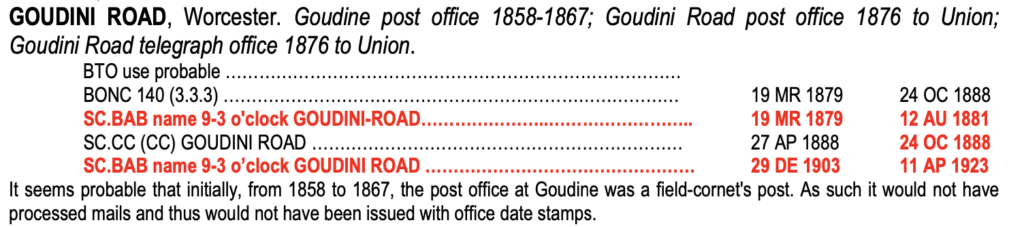
- It seems probable that initially, from 1858 to 1867, the post office at Goudini was a field-cornet’s post. As such it would not have processed mails and thus would not have been issued with office date stamps.
With thanks to the Philatelic Federation of South Africa
-
- Field cornet (Afrikaans: veldkornet) is a term formerly used in South Africa for either a local government official or a military officer.
- The office had its origins in the position of veldwachtmeester in the Dutch Cape colony, and was regarded as being equivalent to a sergeant. The British administration enhanced its importance with the term field cornet, making it equivalent to an officer’s rank.
- The term was used for a civilian official in a local government district (drostdy) of the Cape Colony, acting as and invested with the authority of a military officer and empowered to act as a magistrate. The field cornet was subject to the landdrost of the district and acted as his representative. As such, a field cornet performed important functions in administrative, judicial and police matters. In addition, in peacetime the field cornet was the head of the militia, was responsible for maintaining law and order in his area, and was tasked with supervising the handover of postal items on arrival in his district.
- The term later came to denote a military rank equivalent to that of a lieutenant in the Boer armies as well as in the South African Army between 1960 and 1968. A second lieutenant was referred to as an assistant field cornet.
- The term field cornet replaced the word adjutant in the commando organisation in 1968.
rmed important functions in administrative, judicial and police matters. In addition, in peacetime the field cornet was the head of the militia,
was responsible for maintaining law and order in his area, and was tasked with supervising the handover of postal items on arrival in his district.
The term later came to denote a military rank equivalent to that of a lieutenant in the Boer armies as well as in the South African Army between 1960 and 1968. A second lieutenant was referred to as an assistant field cornet. The term field cornet replaced the word adjutant in the commando organisation
in 1968.
- Field cornet (Afrikaans: veldkornet) is a term formerly used in South Africa for either a local government official or a military officer.
Field Cornet (From Wikipedia, the free encyclopedia)
With thanks to the Philatelic Federation of South Africa
-
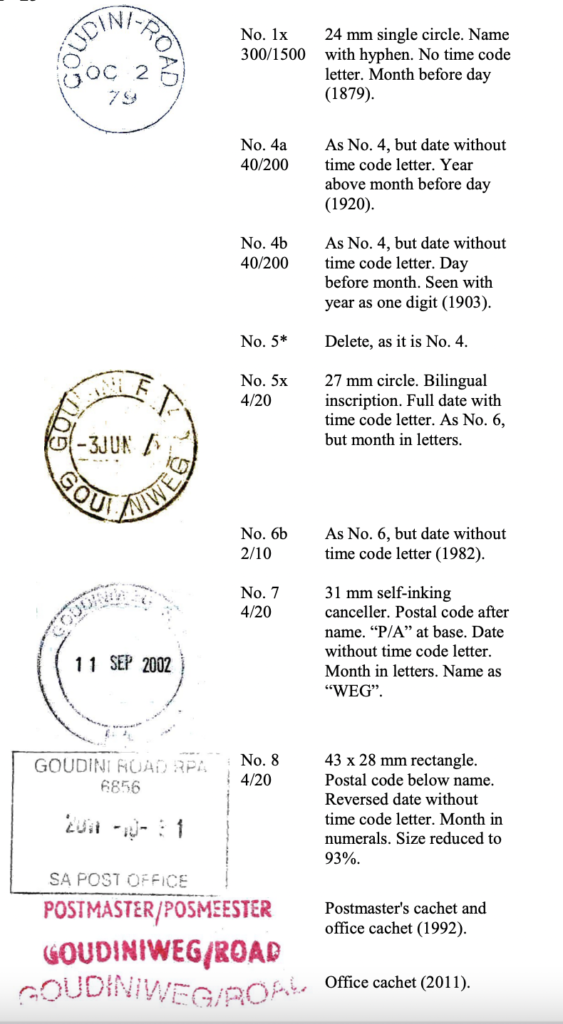
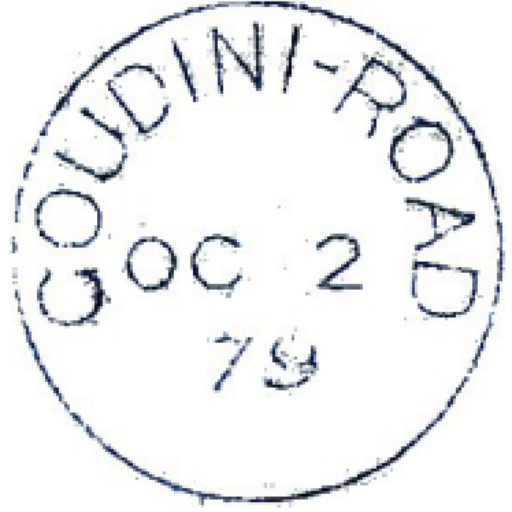
- By 1879 mail was stamped and processed with the following 24mm single circle stamp – dated 2nd Oct 1879.
-
- By 1882 the Cape Colonial Government proclaimed that the railway line should be extended to Robertson. The New Cape Central Railway Company (NCCR) undertook the construction of this line and it was completed in September 1887. Newspapers of the era informed the public of 3 up and 3 down trains on a daily basis. In addition to the new line, railway sidings were established throughout the district. From Cape Town at Breërivier, Botha’s Halt, Goudini Road and Chavonnes. To Kimberley at De Wet, Sandhills and Orchard. On the NCCR line at Overhex and Nuy.